|
|
Green Light for Indigenous Intercultural University Amawtay Wasi of Ecuador
un articulo por Skye Stephenson
Good news for the Indigenous Intercultural University Amwatay Wasi (UIAW) of Ecuador! In May 2012, they received word from the Higher Education Council of Ecuador that their re-accreditation would incorporate intercultural criteria and considerations. The Council further suggested that the development of "intercultural criteria" at the university level will be helpful not only for Ecuador but for other Latin American nations as well.
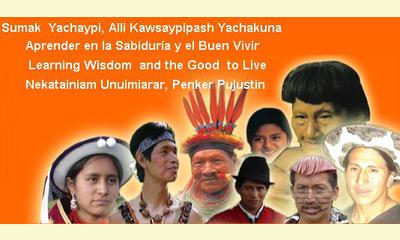
click on photo to enlarge
This decision by the Accreditation Board is an about face of their earlier recommendation to withdraw approval for UIAW in 2009. The change was due to a recent Ecuadorian Supreme Court decision supporting the "unique characteristics" of UIAW. The UIAW leadership, with Rector Luis Fernando Sarango at the helm, carried out a three year legal and cultural struggle.
The decision also drew upon Agreement 169 of the International Labor Organization (ILO). Convention No.169 is a legally binding international instrument open to ratification, which deals specifically with the rights of indigenous and tribal peoples. Today, it has been ratified by 20 countries. Once it ratifies the Convention, a country has one year to align legislation, policies and programmes to the Convention before it becomes legally binding. Countries that have ratified the Convention are subject to supervision with regards to its implementation
Accredited seven years ago by the Ecuadorian government, UIAW has developed an intercultural Andean vision of higher education, offering degree programs in indigenous communities on ancestral architecture, intercultural education, and sustainable agronomy, among others. See www.amawtaywasi.edu.ec for more information.
|


|
DISCUSSION
Pregunta(s) relacionada(s) al artículo :
The understanding of indigenous peoples, Can it help us cultivate a culture of peace?
* * * * *
Comentario más reciente:
:
Two articles in recent years in CPNN point to the renewed recognition of the importance of indigenous knowledge and traditions to help save us from the ecological disaster of the global industrialized economy.
In the article preparing for the upcoming People's Summit in Rio (See CPNN April 12, 2012), Fabiola Ortiz emphasizes the importance of involving indigenous peoples in the decision-making about development projects.
The indigenous peoples of the Amazon made this argument very dramatically and eloquently in person at the World Social Forum in Belem, Brazil, as described the CPNN article of February 6, 2009.

|
|



 por ámbito de acción
 por fecha
