anglais
espagnol
Facebook
Twitter
GLOBAL MOVEMENT FOR A CULTURE OF PEACE

Sur la gauche ci-dessous, vous trouverez un article de CPNN et sur la droite la discussion qui s'y rapporte. Vous êtes invité à lire et à discuter en cliquant sur l'une des questions listées ici, ou, si vous le souhaitez, poser une nouvelle question. Prenez le temps de cocher l'un des boutons ci-dessous en choisissant le niveau de priorité qui doit être donné à cet article.

S'informer Êcrire Lire Accueil L'équipe Discuter Rechercher S'inscrire Contact
par domain d'action
par région
par catégorie
par date
Les Nations Unis et la Culture de Paix
Le Mouvement Mondial pour une Culture de Paix
Valeurs, Attitudes, Actions
CPNN Reglements
Envoyer un Rapport
Devenez un Reporter de CPNN

Workshop on International Human Rights : Constructing a Culture of Peace in Acre (Brazil)

un article par Annie Manuela (Assessoria Sejudh)

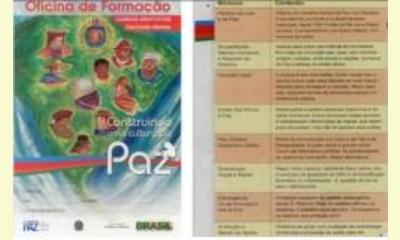
On the 11th and 12th of November, in the auditorium of the State legislature, the Secretariat of Human Rights of the Presidency of Republic will sponsor a workshop on “International Human Rights: Constructing a Culture of Peace.” It will be conducted by the Brazilian Center of Solidarity with Peoples and the Struggle for Peace (Cebrapaz) of Rio Branco, with the support of the government of the State, through the State Secretary of Justice and Human Rights (Sejudh).

Justice and human rights (Sejudh)

The workshop program is based on eight modules on the history of struggle and peace, sociability - human values and respect for others, legal inclusion, people's rights, human rights and media, social, racial and immigrant diversity, and finishing with an evaluation of the Program. Sessions will take place from 8:00-12:00 and 14:00-18:00 with a certificate of participation at the end.

The event is open to everyone who is interested to learn something about International Human Rights, especially concerning the State border with Peru and Bolivia.

Cebrapaz is an internationalist organization that deals with International Human Rights, self-determination of peoples, defending the idea of that each people must decide its proper destination without external interventions. The organization also receives complaints of international human rights violations. Its principle mission is to defend world peace.


(Click here for a Portuguese version of this article)

DISCUSSION

Question(s) liée(s) à cet article:


Is there a new international generation of human rights activism?,

* * * * *

Commentaire le plus récent:

Waging Non-Violent Action in Violent World
(Reflections on  Fletcher International School Course on Strategic Non-Violent Action )

by Imran Khan

“Non-violent refusal to co-operate with injustice is the way to defeat it.” R.M Gandhi

We live in an extremely violent world. States and transnational non-state actors use violence to achieve their political and strategic objectives, believing that use of violence is the most effective way to do so, notwithstanding that it does not work most of the time. Only the last decade (2001-2011) saw 9/11 terrorist attacks, a protracted and bloody war in Afghanistan, the American invasion of Iraq, Israeli aggression against Lebanon and Palestine, 7/7 bombing in London, terrorist attacks in Mumbai in 2008 and so on. Literally hundreds of thousands of people died in these violent conflicts and terrorist attacks. For that matter, the 20th century was perhaps one of the most violent centuries in human history, witnessing two world wars responsible for the deaths of millions of people.

Talking about Pakistan, we are used to violence in this country. In the weeks and months leading up to the creation of Pakistan, the sub-continent witnessed mass killings of both Muslims and Hindus in communal riots. In 64 years of Pakistan’s history, we fought four wars against India. We launched at least four military operations against our Baloch brothers because they offended the state elite by asking for their legitimate rights. . ... continuation.


Cet article a été mis en ligne le November 11, 2011.

Si vous souhaitez poser une nouvelle question liée à cet article, vous devez d'abord vous enregistrer et ensuite inscrivez vous. Ensuite, copiez le titre de cet article (Workshop on International Human Rights : Constructing a Culture of Peace in Acre (Brazil) ) et son numéro (602 ) et entrez ces informations avec votre nouvelle question et une introduction à la question ici.


Les articles sont listés par ordre de priorité selon les votes des lecteurs. Pour cela, vous êtes invité à choisir le niveau de priorité qui doit être donné à cet article en cochant l'un des boutons ci-dessous: Cet article doit-il être prioritaire?